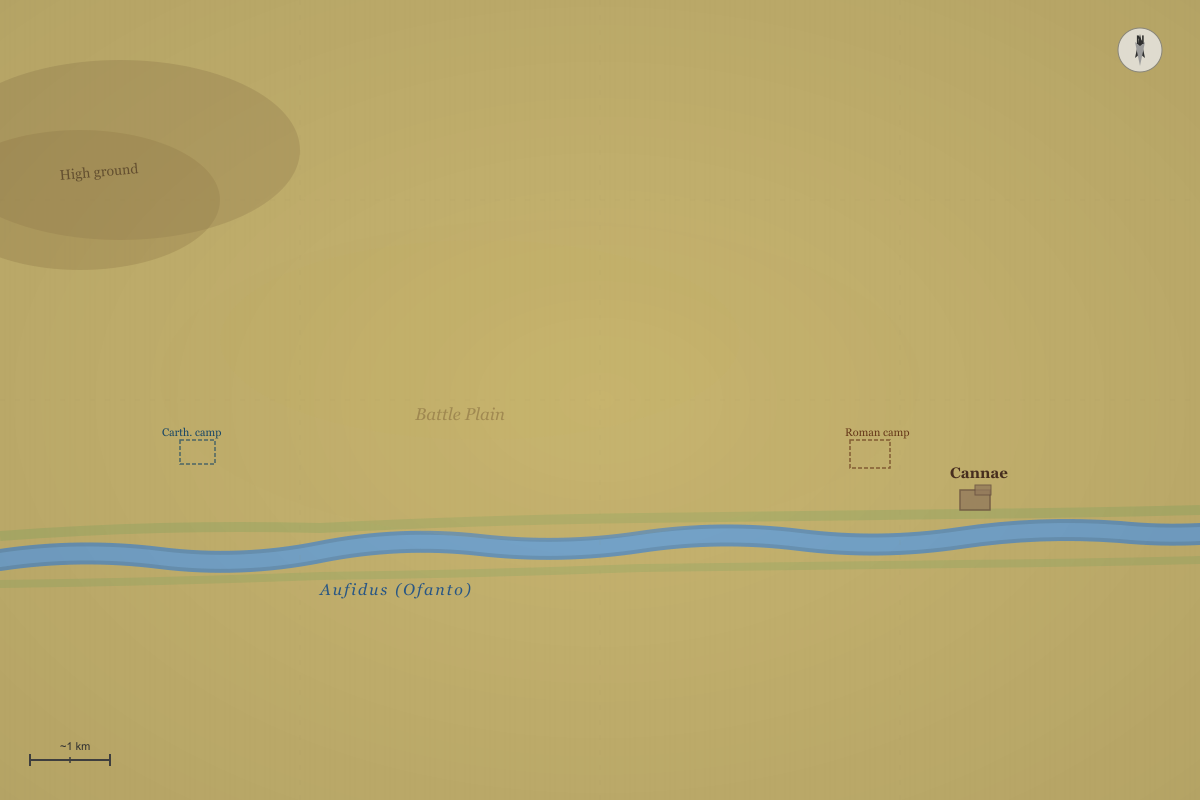
On 2 August 216 BC, Hannibal Barca turned a numerical disadvantage into the most devastating single-day defeat in Roman history — by designing a battle where Rome's strength became its executioner.
historygeopolitics
19 min read·11 sources
It is the morning of 2 August 216 BC The date 2 August is the traditional Roman-calendar (Varronian) date. The equivalent Julian calendar date is disputed: P. S. Derow calculated it as 1 July 216 BC; other scholars have proposed other Julian equivalents. No modern consensus exists. Throughout this piece, '2 August' refers to the Varronian date. on the dusty Apulian plain, and Lucius Aemilius Paullus has a problem he cannot solve with numbers. The consul stands at the head of the largest army Rome has ever fielded — Polybius (Book 3) gives 80,000 foot and 6,000+ horse. Livy concurs on approximately eight legions, an unprecedented commitment. Wikipedia and modern scholars broadly confirm the range, though the exact engaged figure is debated — Warfarehistorynetwork.com puts the combatant total at 76,400 after garrisoning the camps. — with orders from a Senate that has run out of patience to destroy Hannibal Barca before Hannibal destroys the alliance that holds Italy together. The Carthaginian army across the plain is smaller. Polybius gives Hannibal 40,000 foot and 10,000 cavalry. Livy is consistent. Modern scholars (Lazenby, Goldsworthy) accept the approximate figure of 40,000–50,000 total, with the infantry count at roughly 32,000–40,000 depending on whether camp detachments are included. Paullus knows it. Every tribune knows it. What no one on the Roman side has yet understood is that Hannibal has designed this battle around that knowledge — around Rome’s certainty that weight and numbers must win.
They will not survive the understanding.
The Road to the Plain
Two years before Cannae, Hannibal’s army does not exist in Italy. It crosses the Alps in the autumn of 218 BC — The Second Punic War timeline is well-attested across Wikipedia (Second Punic War), Polybius, and Livy. Hannibal crossed with perhaps 26,000 infantry and 6,000 cavalry by some estimates, down from a larger Iberian starting force. — and descends onto the Cisalpine plain already depleted, already fighting for forage. Rome responds the way Rome always responds: send armies. In December 218 BC, at the River Trebia in northern Italy, Hannibal lures a Roman force under Sempronius Longus into a freezing dawn engagement and destroys it. Trebia casualties: Wikipedia (Battle of the Trebia), corroborated by World History Encyclopedia (Second Punic War). These are primary-source-derived figures from Polybius and Livy.
Rome sends more armies. In June 217 BC, at Lake Trasimene in Etruria, Hannibal ambushes the consul Gaius Flaminius in a valley with the lake at his back. Flaminius dies in the rout. His army — some Trasimene casualties from Wikipedia (Battle of Lake Trasimene) and World History Encyclopedia (Second Punic War). Polybius and Livy are the primary sources. — ceases to exist in the space of three hours. Rome has now lost two consular armies in six months. The Senate, for the first time in generations, appoints a dictator.
Event 1 of 7: 1 May 218, Hannibal leaves Iberia
01218opening
1 May 218
Hannibal leaves Iberia
Marches from New Carthage (Cartagena) northward with approximately 90,000 infantry, 12,000 cavalry, and 37 war elephants.
02218+5 mo
15 Sep 218
Alpine crossing begins
The famous march over the Alps costs Hannibal roughly half his force to cold, disease, and hostile tribes. He descends into Cisalpine Gaul with perhaps 26,000 infantry and 6,000 cavalry.
03218+3 mo
22 Dec 218
Battle of the Trebia
Hannibal lures Sempronius Longus into a dawn engagement. Only 10,000 of roughly 40,000 Roman troops escape — the first major defeat on Italian soil.
04217+2 yr
21 Jun 217
Battle of Lake Trasimene
Hannibal ambushes Consul Flaminius. Approximately 15,000 Romans are killed and 10,000 captured. Flaminius himself dies in the fighting.
05217+10 days
1 Jul 217
Quintus Fabius Maximus appointed dictator
The Senate turns to a strategy of avoidance — no pitched battles, but cutting Hannibal's supply lines and harassing his foraging parties. Fabius earns the nickname cunctator ('the Delayer').
06217+5 mo
1 Dec 217
Fabius's dictatorship expires
The Fabian strategy is unpopular: Roman allies watch Hannibal plunder their lands while Rome does nothing. The Senate returns to consular command and elects men with a mandate to fight.
07216+1 yr
2 Aug 216
Battle of Cannae
The new consuls — Varro and Paullus — field eight legions. Hannibal annihilates them in a single afternoon.
The Second Punic War — road to Cannae
Quintus Fabius Maximus earns the cognomen cunctator — the Delayer — and the strategy he pursues is sensible: avoid pitched battle, strip Hannibal of forage, let distance and time bleed the Carthaginian army that cannot be reinforced. But it is politically untenable. The *socii* or allied states of Italy supplied roughly half of Rome's military manpower. Their loyalty depended on Roman protection — visible, military protection. Hannibal's march through their lands, uncontested, was a direct challenge to that relationship. World History Encyclopedia (Battle of Cannae) and warfarehistorynetwork.com both describe this political pressure as forcing the strategic rethink. watch Hannibal burn their farms. They begin to wonder whether Roman protection means anything at all. By the winter of 217 BC, Fabius is out and a new pair of consuls is elected with a simple mandate: find Hannibal and destroy him.
The political failure of the Fabian strategy deserves a moment’s examination, because it explains the specific shape of the disaster at Cannae. Fabius’s approach — The Fabian strategy is described in detail at Wikipedia (Fabian strategy) and in multiple ancient sources. Fabius's logic was sound: Hannibal's army in Italy was strategically isolated, too far from Carthaginian territory to be reinforced, and dependent on living off the land. Starvation and attrition would ultimately win without further risk. His failure was political, not strategic. — was strategically sound and politically unsustainable in equal measure. Rome was a republic of competing aristocratic careers; military glory was the currency of advancement. A dictator who refused to fight was suspected of cowardice or, worse, of angling for personal power by prolonging the emergency. When Fabius’s term expired, his master of horse Marcus Minucius Rufus fought an unauthorized battle and claimed a partial victory, earning a hero’s welcome in Rome and a co-dictatorship — the only time in Roman history the office was shared. The Senate was signaling that it wanted battles, not strategy.
The consuls elected for 216 BC, Gaius Terentius Varro and Lucius Aemilius Paullus, represented this political consensus. Varro was a populist — ancient sources hostile to him claim he was a butcher’s son, which is probably slander, but his political base was certainly the assembly rather than the Senate. Paullus was an aristocrat who had some personal familiarity with military caution: he had commanded in Illyria and was less enthusiastic about a frontal engagement with Hannibal. The arrangement — two consuls alternating daily command — The alternation of supreme command between Varro and Paullus on alternate days is attested by both Polybius and Livy, and discussed across World History Encyclopedia (Battle of Cannae) and Wikipedia. The rotation was a standard Roman constitutional mechanism, not a special arrangement for Cannae. It meant that on any given day, one consul's judgment could override the other's — and on 2 August, it was Varro's day. — was a constitutional norm, not a Cannae-specific decision. But its effect was to guarantee that on the morning of 2 August, when Hannibal deployed on favorable ground, the man in command was the one who wanted to fight.
Hannibal helps them find him. He marches south into Apulia and seizes Cannae — a hilltop depot where Rome stockpiles grain for the armies in the region. It is not a casual choice. History.com and World History Encyclopedia both note that Hannibal deliberately occupied Cannae knowing that the Romans could not ignore a threat to their primary supply magazine in the region — it forced the engagement on terrain of his choosing. The depot cannot be ceded without appearing helpless before the very allies Rome is trying to reassure. Varro and Paullus march south. On 1 August 216 BC, the two armies camp on opposite banks of the Aufidus.
What meets on the Aufidus plain is not a close fight. Rome has brought the largest army in its history — eight full legions plus allied contingents, commanded by two consuls who rotate supreme command daily. The daily alternation of command between Varro and Paullus is attested by both Polybius and Livy. Tradition blames Varro for forcing battle on the 2nd of August (his day of command) over Paullus's objections. World History Encyclopedia and warfarehistorynetwork.com both describe this command tension. The army is organized in the traditional Roman triplex acies — Rome's three-line battle formation: the hastati (youngest) in front, the principes (prime-age veterans) behind them, and the triarii (oldest, with spears) in a final reserve. Each legion numbered roughly 4,500 men in four lines including light infantry (velites) skirmishers. — but with a critical modification. Varro has deepened the maniples beyond standard depth, compressing the formation to create a dense, punching mass. The idea is to drive through Hannibal’s center by sheer weight, as they believe they can.
The standard Roman fighting system required space. The importance of individual fighting room to Roman gladius technique is discussed in detail in War on the Rocks (2025), World History Encyclopedia (Battle of Cannae), and is implicit throughout Polybius's description of the engagement. Each Roman legionary needed roughly a meter of lateral space to use his scutum (shield) for deflection and his gladius for thrusting — tight-packed, he could do neither effectively. The legionary’s weapons — a large rectangular scutum shield and a short stabbing sword, the gladius hispanensis — were designed for close-quarters individual combat. Each man needed approximately a meter of lateral space to work: room to plant his feet, room to receive a blow on the shield and push back, room to thrust the sword in the gap between his own shield and his enemy’s. Varro’s deepened formation, by closing that gap, traded Roman tactical effectiveness for Roman mass. The men in the second, third, and fourth ranks could not fight; they could only push. They were a battering ram — massive, linear, and essentially incapable of responding to anything that happened to either flank. Against a conventional enemy who would meet them straight on and yield or hold, this would be decisive. Against the mechanism Hannibal had prepared, it was the instrument of their own destruction.
Against this, Hannibal arrays perhaps Polybius Book 3 gives these figures; Livy concurs. Modern assessments (Goldsworthy, Lazenby) broadly accept them with the caveat that ancient sources sometimes conflate different counting methods. — with one crucial asymmetry. His cavalry outnumbers Rome’s two to one in total, and in quality the Numidian horse on his right wing has no peer in the ancient world.
Rome & AlliesvsCarthage & Allies
Infantry
2:1
Cavalry
1.6:1
Total strength (incl. garrisons)
1.7:1
Engaged on field (excl. camp garrisons)
1.5:1
Force comparison: Rome & Allies vs Carthage & Allies
Metric
Rome & Allies
Carthage & Allies
Ratio
Infantry
80,000 men
40,000 men
2:1
Cavalry
6,400 men
10,000 men
1.6:1
Total strength (incl. garrisons)
86,400 men
50,000 men
1.7:1
Engaged on field (excl. camp garrisons)
76,400 men
50,000 men
1.5:1
Cannae — strength going in (2 August 216 BC)
Roman and Allied Army
cmd Consuls Lucius Aemilius Paullus & Gaius Terentius Varro
3 formations
Roman citizen cavalry (right wing)wing≈2,400
cmd Consul L. Aemilius Paullus positioned along the Aufidus riverbank, cramped ground restricted maneuver
Roman equites (citizen cavalry)≈2,400met Hasdrubal's Iberian/Gallic horse; routed after fierce fighting
Heavy infantry (center)corps≈55,000–65,000
cmd Consul Gaius Terentius Varro / former consul Cn. Servilius Geminus deepened beyond standard maniple depth — Varro's battering-ram design
Roman citizen legions (I–IV)≈25,000hastati, principes, triarii
Allied Latin legions (V–VIII)≈30,000matching structure to Roman legions
Light infantry velites (both armies)≈15,000forward screen; withdrew through maniple gaps before main engagement
Allied cavalry (left wing)wing≈4,000
cmd Allied cavalry tribunes faced Maharbal's Numidians; held longer than the right wing through prolonged skirmishing
Carthaginian and Allied Army
cmd Hannibal Barca
4 formations
Iberian and Gallic heavy cavalry (left wing)wing≈6,000
cmd Hasdrubal (distinct from Hannibal's brother) placed in narrow ground between infantry and river; won quickly, then rode to the far wing
Iberian cavalry≈2,000armored, shock cavalry
Gallic cavalry≈4,000Boii and Insubres; renowned fighters
Infantry center — the yielding crescentcorps≈24,000–26,000
cmd Hannibal Barca (center), Mago Barca (brother, center) Iberians and Gauls deployed in a deliberately convex bulge — designed to bend backward
Gallic infantry≈16,000–18,000Boii, Insubres, Volcae; often unarmored, round/oval shields, longswords
Libyan heavy infantry (both flanks of center)corps≈8,000–10,000
cmd Sub-commanders of Hannibal equipped with captured Roman arms from Trebia and Trasimene; held motionless on the outer edges of the crescent, then wheeled inward
Libyan spearmen (left flank column)≈4,000–5,000veteran African infantry in Roman equipment
Libyan spearmen (right flank column)≈4,000–5,000mirror column on opposite side
Numidian cavalry (right wing)wing≈4,000
cmd Maharbal (or Hanno; sources vary on the right-wing commander's name) finest light cavalry in the ancient world; feigned retreats, harassed the allied horse for hours
Numidian light cavalry≈4,000javelin-armed, unarmored horsemen from modern Tunisia/Algeria; unmatched for mobility
Order of battle — Cannae, 2 August 216 BC
The formation on each side deserves examination before the killing begins, because the formation is the argument.
Hannibal has placed his weakest infantry at the center of his line — Polybius describes Hannibal deploying the Iberian and Celtic (Gallic) troops in an alternating arrangement at the center, with the Libyans on each side. The Gauls and Iberians were brave fighters but less disciplined than the Roman legionaries; their role was not to hold but to absorb and yield. Sources: Polybius (Fordham Sourcebooks), Livy (johndclare.net), Wikipedia. — arranged in a gentle convex arc bowing toward the Roman lines. On each outer edge of that arc, he has posted his Libyan veterans. They stand still and they do not advance. They wait. His cavalry, which outnumbers Rome’s two to one, anchors both wings. On his left near the river, Hasdrubal commands the Iberian and Gallic heavy horse; on his right, Maharbal leads the Numidians.
Paullus can see most of this. What he cannot see is the mechanism: that the convex center is a designed collapse, that the stationary Libyans are hinges, and that his cavalry’s numerical weakness — known and accepted — is the battle’s lever.
The Battle: Phase by Phase
1 / 5Deployment: the plain along the AufidusDawn, 2 Aug
Rome deploys infantry mass in center, cavalry on wings. Hannibal anchors his left on the river; his infantry center bows forward in a convex crescent, Libyans on each outer end.
step through the battle · ← → to advance · click a unit for strength
Phase 1 of 5: Deployment: the plain along the Aufidus
sides
Rome & Allies
Carthage & Allies
units
infantry
armor
cavalry
artillery
hq
naval
air
1Deployment: the plain along the AufidusDawn, 2 Aug
Rome deploys infantry mass in center, cavalry on wings. Hannibal anchors his left on the river; his infantry center bows forward in a convex crescent, Libyans on each outer end.
8 units · 2 fronts
Rome & Allies cavalry — Roman cavalry (Paullus) (≈2,400)
Rome & Allies infantry — Roman legions (Geminus/Varro) (≈65,000)
2Cavalry clash: Hasdrubal routs the Roman rightEarly morning
Hasdrubal's 6,000 Iberian-Gallic cavalry charge the Roman citizen cavalry in narrow ground between the infantry and the Aufidus. Polybius notes they fight partly dismounted. The Romans are overwhelmed and flee along the riverbank.
7 units · 2 moves · 2 fronts
Rome & Allies cavalry — Roman cavalry (routing) (≈2,400)
Rome & Allies infantry — Roman legions (advancing) (≈65,000)
3The center yields: Roman legions press into the pocketMid-morning
The Roman infantry mass hits the Gallic/Iberian crescent. The center begins to bend backward under pressure — controlled, deliberate. Romans interpret this as success and press harder, compressing into an ever-tighter mass. Libyan flanks hold in place.
7 units · 2 moves · 2 fronts
Rome & Allies infantry — Roman legions (deep press) (≈65,000)
With the Roman mass fully committed and compressed, the Libyan infantry on both flanks wheels 90° inward, attacking the exposed Roman sides. Hasdrubal has finished off the allied cavalry and is riding hard for the Roman rear.
6 units · 3 moves · 1 front
Rome & Allies infantry — Roman mass (compressed, flanks exposed) (≈65,000)
Carthage & Allies cavalry — Hasdrubal (riding for Roman rear) (≈6,000)
Carthage & Allies infantry — Gallic/Iberian center (concave, holding) (≈24,000)
5Encirclement complete: the double envelopmentMidday
Hasdrubal's cavalry strikes the Roman rear. The Libyans hold both sides. The Gallic/Iberian center — now concave — closes the front. 70,000+ Romans are surrounded, unable to maneuver, unable to use their weapons in the press. The killing proceeds until evening.
5 units · 1 move · 2 fronts
Rome & Allies infantry — Roman army (encircled, ~70,000)
Cannae, 2 August 216 BC — phase-by-phase tactical replay
Phase 1 — Deployment: Hannibal Chooses the Ground
The plain itself is part of the weapon. The terrain and weather conditions at Cannae are discussed in World History Encyclopedia (Battle of Cannae) and Wikipedia. The Aufidus (modern Ofanto) river constrained the northern flank. Ancient sources also note that Hannibal arranged his troops with the wind — a hot, dust-laden sirocco — blowing into the Roman faces, adding physical discomfort and obscuring visibility. The dust factor is attested in ancient accounts via World History Encyclopedia. The Aufidus river on the northern side narrows the field, removing the Romans’ ability to extend their line outward and use their numerical superiority in breadth. In August on the Apulian plain, the wind blows from the southeast — a hot, dry sirocco that carries dust. Hannibal positions his army so the wind is at his men’s backs and in the faces of the Roman front rank: a minor edge, but in a battle where visibility and cohesion determined everything, it is a deliberate choice.
Dawn on the plain. Hannibal is in position first, which matters. World History Encyclopedia (Battle of Cannae) notes explicitly: 'Because Hannibal had been in position first, his location dictated the Roman deployment and field of battle.' He places his left wing — Hasdrubal’s 6,000 Iberian and Gallic cavalry — in the narrow space between the Aufidus riverbank and the mass of infantry. The river behind that wing is not a danger; it is a funnel. Roman cavalry sent against it cannot maneuver. It can only fight straight at Hasdrubal’s men, and Hasdrubal has twice their number.
At the center of his line, Hannibal arranges the Gallic and Iberian infantry in an unusual shape: bowing outward toward Rome, a gentle convex crescent. He and his brother Mago station themselves here, among the men they need to hold just long enough. Polybius (Book 3, via Fordham Sourcebooks) describes Hannibal drawing out the Hispanic and Celtic infantry and 'advancing with them ... gradually falling off, so as to produce a crescent-shaped formation.' The convex bow was intentional — it invited the Roman advance and positioned the Libyan flanks correctly. On each outer edge of that crescent stand the Libyan veterans, armed with Roman weapons taken from the dead at Trebia and Trasimene. They are ordered to do nothing — not yet.
On the far right, the Numidian cavalry — The identity of the Numidian right-wing commander is genuinely disputed in the ancient sources. Polybius, the closest primary source and the one cited throughout this piece for tactical detail, names Hanno (son of Bomilcar) as the commander on the Carthaginian right. Livy names Maharbal. Appian places Maharbal in a different role. The Maharbal reading is the traditional one, and he remains the source of the famous post-battle exchange, but Polybius's assignment to Hanno should be noted. This piece uses 'Maharbal' as the conventional name while acknowledging the dispute. — commands 4,000 Numidians against the allied Italian cavalry. Their orders are not to win quickly; they are to keep the allied horse occupied while Hasdrubal finishes on the other side.
Phase 2 — Hasdrubal Clears the Right Wing
The battle opens with light infantry skirmishing across the front — velites against Numidian skirmishers, an inconclusive exchange that settles nothing. The real opening move belongs to Hasdrubal.
His Iberian and Gallic heavy cavalry charge the Roman citizen cavalry in the narrow strip of ground along the Aufidus. Polybius records that the engagement becomes so fierce that horses cannot maneuver, and both sides dismount to fight on foot, hand to hand. Polybius (Book 3, Fordham Sourcebooks): the Iberian and Celtic cavalry 'engaged the Roman cavalry in a fierce contest. Not content with fighting on horseback ... they at once dismounted and fought man to man.'
Not content with fighting on horseback, they at once dismounted and fought man to man; and then the Celts and Iberians … not only succeeded in routing the enemy from the field, but followed up the pursuit along the river bank.
Polybius, Histories, Book 3 (tr. Shuckburgh) — the cavalry fight at Cannae
source
The Roman citizen cavalry — roughly 2,400 against 6,000 — breaks and flees along the riverbank. Consul Paullus survives with his bodyguard. His cavalry wing does not.
Hasdrubal does not pursue. He detaches a small force to harry the fugitives and turns his entire command toward the far side of the field, where Maharbal has been holding the allied Italian cavalry at bay for hours through a running series of Numidian feints and retreats. Polybius and Livy both describe Hasdrubal breaking off the pursuit and riding across the Carthaginian rear to support the Numidians. This is the critical linking move — the one that makes the rear attack possible. warfarehistorynetwork.com, history.com, and World History Encyclopedia all attest the sequence.
Phase 3 — The Legions Enter the Pocket
The infantry engagement opens as expected — from the Roman perspective. The heavy legions crash into the protruding Gallic and Iberian crescent. The Carthaginian center bends back. The Romans press forward. This is what Romans do: they push, they tighten their formation, they drive through. Polybius describes the Romans deepening their maniples beyond standard practice on Varro's orders. The intent was to create a punching mass. The unintended effect was to make the army increasingly immobile as it drove forward — it could not respond to flanking threats. Wikipedia and warfarehistorynetwork.com both note this tactical choice.
What no Roman front-rank soldier can see is that the center is not breaking. It is bending, and there is a difference. The Gauls and Iberians fall back step by step, compressed into a concave line, but they hold formation. The Libyan columns on each outer edge of the original crescent advance not at all. They stand like pillars, and as the Roman mass pushes through the center, those pillars become the walls of a narrowing corridor.
Hannibal is somewhere in the middle of this. So is Mago. The act of being among the yielding troops is its own kind of command — men who can see their general do not run.
Phase 4 — The Pivot: Libyan Infantry Wheels Inward
The signal comes — from Hannibal, from the shape of the line, from the simple fact that the Roman mass has pushed far enough into the pocket. The Libyan columns on both flanks wheel 90 degrees, inward, and slam into the exposed Roman sides simultaneously.
This is the moment Hannibal designed. The legionaries in the center are packed so tightly they cannot raise their shields. They cannot swing their gladii. Livy describes Romans 'suffocated' in the press; the tactical analysis from warontherocks.com notes explicitly that 'Roman style of fighting required reasonably large intervals' — the compressed formation eliminated the space every Roman soldier needed to fight effectively. They are fighting men in front and flanked on both sides, and the Libyan veterans coming in from each side are equipped with captured Roman equipment — the same scutum, the same pilum — so even experience offers no edge.
Hasdrubal arrives at the Roman rear.
The encirclement is complete. What has been a battle becomes something else.
Phase 5 — Annihilation
There is no polite way to describe what happens now. The Roman army, somewhere between The exact number engaged varies by source. Wikipedia gives the engaged total (excluding camp garrisons) as approximately 76,400; warfarehistorynetwork.com concurs. Some of the 86,400 total were left guarding the camps. in number, is surrounded on all four sides. Hasdrubal’s cavalry holds the rear. The Libyan infantry holds the sides. The now-concave Gallic and Iberian center — bloodied but intact — closes the front. The Numidians have dispersed the allied Italian cavalry and complete the outer cordon.
Men in the center begin dying not from blows but from the press — crushed, suffocated. Livy, drawing on near-contemporary accounts, describes the wounded Carthaginian soldiers scratching and biting at the Romans standing over them. Livy's vivid account of the encirclement's closing stages is available in English via johndclare.net. He writes of the press being so great that men died from compression; wounded Carthaginian soldiers 'scratched and gnawed as Romans stood over them dying, gouging and biting in the press.' The dramatic detail is Livy's; the tactical reality is confirmed by Polybius. Paullus is wounded, probably early in the infantry fight. He dies on the field, on foot, fighting, refusing the horse of a young tribune who offers his.
Consul Varro escapes to the east with perhaps 70 cavalry. He is the day’s ranking survivor.
The killing continues until dusk. When it ends:
In this battle it is said that the Romans lost seventy thousand men, and the Carthaginians about six thousand, of whom four thousand were Celts, fifteen hundred Iberians and Africans, and two hundred cavalry.
Polybius, Histories, Book 3 (tr. Shuckburgh)
source
The Reckoning
The casualty figures at Cannae are among the most contested in ancient military history — and the most staggering.
Go deeper: the casualty debate
Polybius reports 70,000 Roman dead. Livy gives different numbers depending on the section: one passage totals 45,500 foot soldiers and 2,700 cavalry killed — 48,200 total — along with 19,300 captured. Modern historians are more skeptical: Cantalupi (1891) proposed 10,500–16,000 actual dead; Clodfelter in his survey of military casualties writes with evident skepticism about the higher ancient figures; Samuels (1990) questioned Livy’s count as inflated by the Roman narrative of catastrophe. Warfarehistorynetwork.com summarizes the range: Wikipedia and warontherocks.com present the consensus view that even the lowest modern estimates represent an enormous single-day loss. The range of serious scholarly estimates for Roman dead runs from roughly 30,000 (cautious modern) to 70,000 (Polybius). This piece uses ranges accordingly, following the corroborated-range principle.
What is not disputed is the character of the loss. Among the Roman dead were Livy records 29 military tribunes killed and 'some eighty further men of consular, praetorian, or aedile rank' (via johndclare.net). The total of 'roughly four dozen' tribunes present follows from eight legions with six tribunes each — a reasonable inference, but ancient sources do not state this total directly. The loss of senatorial rank is particularly striking — it represents a generational blow to Rome's governing class. — the managerial class of the Roman army and the political class of the Republic, most of them dead on the same afternoon. Gnaeus Servilius Geminus, former consul, dies in the fighting. Marcus Minucius Rufus, former master of horse, dies with him. Of Rome’s 300-man Senate, perhaps 80 will never come home.
Rome & AlliesvsCarthage & Allies
Dead (Polybius)
12:1
Dead (Livy)
6:1
Captured
—
Escaped
3.1:1
Force comparison: Rome & Allies vs Carthage & Allies
Metric
Rome & Allies
Carthage & Allies
Ratio
Dead (Polybius)
70,000 men
5,700 men
12:1
Dead (Livy)
48,200 men
8,000 men
6:1
Captured
19,300 men
0 men
—
Escaped
14,500 men
44,300 men
3.1:1
Cannae — the butcher's bill (all figures approximate ranges from ancient sources)
total 82000 men
Roman force (Livy's total, ≈82,000) → Killed in battle: 48200 men(58.8%)
Roman force (Livy's total, ≈82,000) → Captured: 19300 men(23.5%)
Roman force (Livy's total, ≈82,000) → Escaped / survived: 14500 men(17.7%)
Roman army at Cannae — approximate fate (Livy's figures: 48,200 killed + 19,300 captured + ~14,550 escaped ≈ 82,000 total)
For Carthage, the losses are perhaps Polybius gives 4,000 Gauls, 1,500 Iberians and Africans, and 200 cavalry — total 5,700. Livy writes of 'about 8,000 of his bravest men.' Both Polybius and Livy are available via the Fordham Sourcebooks and johndclare.net respectively. The discrepancy is typical of ancient casualty reporting. — a ratio of roughly eight or nine Roman dead for every Carthaginian, depending on which count one accepts. Even the conservative modern figure of 30,000 Roman dead produces a ratio of more than five to one.
The Aftermath: What Cannae Set in Motion
The news reaches Rome by nightfall. The Senate convenes under torchlight. The details arrive in fragments, each worse than the last.
But below the official composure, the human damage is catastrophic. World History Encyclopedia and history.com both note that Rome, in its desperation, resorted to human sacrifice — burying alive two Gauls and two Greeks in the Forum Boarium as a propitiatory rite. This extraordinary act, so alien to Roman religious practice, signals how close the psychological break was. No family in Rome is untouched. Multiple Italian city-states defect to Hannibal in the months that follow — Capua, the second city of Italy, among them. Philip V of Macedon negotiates an alliance with Hannibal. The Mediterranean strategic landscape shifts.
And then Maharbal says something that will be repeated for the next 2,200 years.
You know how to win a victory, Hannibal; you do not know how to use one.
Livy, Ab Urbe Condita, Book 22 — Maharbal's rebuke, paraphrased (Latin: 'Vincere scis, Hannibal; victoria uti nescis')
source
Hannibal declines to march on Rome. The logic for this decision is contested even today. Maharbal's line and Hannibal's refusal are attested in Livy (Book 22). The strategic debate about whether Hannibal could have taken Rome directly after Cannae has occupied historians ever since. warontherocks.com (2025) argues compellingly that Hannibal never had the siege equipment or supply base to take a walled city; Rome retained two legions for its defense; and Hannibal's strategic position depended on Italian allies defecting voluntarily, not on conquest. The refusal may have been strategic realism rather than a failure of nerve. His army lacks siege equipment. Rome’s walls are intact, and the city still has two legions defending it. His strategy has never been to conquer Rome by storm — it has been to break the Italian alliance system, peel away Rome’s allies, and force a negotiated peace from a position of demonstrated military superiority. Cannae should have been enough. The Roman Senate has different ideas.
Rome’s response to Cannae is, in its own way, as remarkable a study in organizational behavior as Cannae is in tactics. Three decisions stand out.
First, the refusal to ransom prisoners. Rome's refusal to ransom the prisoners taken at Cannae is recorded by Livy and discussed in World History Encyclopedia (Battle of Cannae) and Wikipedia (Battle of Cannae). Hannibal offered to sell the prisoners back at what ancient sources describe as a 'reasonable' price. The Senate's refusal was partly financial calculation — it denied Hannibal cash — but also a political signal: captivity was not a respectable Roman outcome, and the Senate refused to legitimize it by paying ransoms. Some prisoners were eventually sold into slavery across the Mediterranean. Hannibal held somewhere between 10,000 and 19,300 men (the sources vary, but he held many). He offered to sell them back. The Senate refused. The message was two-fold: Rome would not fund Hannibal’s war machine with Roman gold, and Rome would not normalize the idea that being captured by Hannibal was an outcome worth rescuing. The prisoners were not dishonored publicly — but they were abandoned.
Second, the mobilization. Within months of Cannae, Rome was raising fresh armies at a rate that should have been impossible. The scale of Rome's post-Cannae mobilization is described across Wikipedia (Second Punic War), warontherocks.com (2025), and World History Encyclopedia. Rome mobilized slaves (the volones) — an unprecedented act — and extended military service to men below the standard property qualification. By 215 BC, Rome had rebuilt to roughly 110,000 under arms. They enrolled slaves — the volones — into the legions, an act without precedent in Roman history, offering freedom in return for service. They extended the military census to cover men below the normal property qualification. They called in every obligation owed by every Latin and allied community. The result, within two years of Cannae, was a Roman military presence of over 100,000 men across multiple theaters — Italy, Spain, Sicily, Sardinia — simultaneously. The manpower pool that sustained this effort, the combination of Roman citizens and Latin and Italian allies, was the structural reality Hannibal had always underestimated.
Third, and most consequential, the refusal to negotiate. The episode of Carthalo — Hannibal's envoy sent to Rome after Cannae — is in Livy Book 22. The Senate refused to receive him; the historical tradition records that it was decreed that no embassy from Hannibal would be heard while his army remained in Italy. World History Encyclopedia (Battle of Cannae) confirms this detail. The decision was strategically transformative: it meant Hannibal's strategy of negotiated peace through battlefield superiority was foreclosed. Hannibal sent an envoy, Carthalo, to Rome after Cannae with peace proposals. The Senate refused to receive him. A formal decree barred any Carthaginian embassy from being heard while Hannibal remained on Italian soil. This single act dismantled Hannibal’s entire strategic theory. He had not come to conquer Rome; he had come to demonstrate to Rome that the current terms of Italian hegemony were unsustainable, and force a renegotiation. Rome’s refusal to negotiate meant that every subsequent Hannibalic victory — and there would be more — simply prolonged the war rather than ending it. Cannae had not been enough because the Roman Senate decided it would not be enough.
The strategic consequences rippled outward. Capua — the second city of Italy, wealthier and more populous than most Italian communities — defected to Hannibal in late 216 BC. Capua's defection to Hannibal after Cannae is one of the war's pivotal events. Wikipedia (Second Punic War) and World History Encyclopedia both describe it in detail. The defection of Tarentum followed in 212 BC. But Hannibal could not hold Capua against Roman siege — it fell in 211 BC, and the Senate made an example of it, stripping its civic status entirely. The reconquest of Capua demonstrated that Hannibal could cause defections but could not protect his new allies. Tarentum, the largest Greek city in southern Italy, followed. Philip V of Macedon, sensing Roman weakness, negotiated a formal alliance with Carthage. For a moment — perhaps the only moment in the war — the strategic map looked genuinely dangerous for Rome. Multiple Italian communities were wavering. Rome was fighting on three continents simultaneously. Yet none of these consequences translated into the decisive blow that would have followed at Cannae if Rome had been a different kind of polity. Capua was besieged by 212 BC and fell in 211 BC. Philip V never sent an effective force to Italy. The defecting cities found that Hannibal could defend them in open battle but could not protect them against Roman siege operations.
The cavalry imbalance was the lever of the whole envelopment. Without cavalry superiority — which Rome chose to discount — the Libyan pivot and the rear attack cannot happen.
which drives
Varro's deepened formation, designed to punch through, instead created an immobile mass that could not respond to flanking threats. The tactical choice that should have been Rome's strength became its trap.
therefore
The three-part mechanism works in sequence: Hasdrubal clears the right, then rides left; Libyans wheel; Hasdrubal attacks from behind. Roman army is encircled with no exit.
therefore
The compression of the pocket renders Roman fighting technique (which requires room for the individual soldier's sword-arm) useless. The killing is slow and grinding, not a rout. Romans die fighting, unable to act.
therefore
Capua defects. Tarentum follows. The alliance system Hannibal came to break begins to crack — exactly as planned.
and so
The Senate's refusal to ransom prisoners or discuss peace transforms Cannae from a decisive victory into a step in a longer war. Hannibal cannot take Rome by storm; Rome will not sue for peace. The 17-year war continues.
How Cannae's tactical perfection became strategic stalemate
The deeper truth is this: Cannae is tactically perfect and strategically incomplete. Hannibal destroys an army. He cannot destroy a state. Rome’s ability to field replacements — These mobilization figures are from warontherocks.com (2025), drawing on ancient sources and modern demographic analysis. The figures illustrate Rome's extraordinary manpower reserve — what military historians call the 'Latin pool' — which Hannibal could not exhaust by winning battles alone. — is without parallel in the ancient world. Scipio Africanus will eventually carry the war to Africa, fight Hannibal at Zama in 202 BC using adapted Cannae tactics (feigning a yielding center, sweeping the cavalry), and end the Second Punic War on Roman terms. Hannibal dies in 183 BC in exile, taking poison rather than surrender to Rome.
Why Cannae Still Matters
The road from Cannae to the end of the Second Punic War takes sixteen years. What happens in that interval is essentially a case study in the limits of tactical genius without strategic leverage.
Hannibal wins battles. He wins several more — at Nola, at Herdonea, in skirmishes across the south. He cannot take walled cities. He cannot replace his losses; Carthage, consumed by domestic politics and its ongoing Spanish war, sends him inadequate reinforcements through most of the Italian campaign. The Italian alliance does crack — but not all the way. The Latin cities, the bedrock of Rome’s manpower reserve, never defect. Without them, Hannibal’s attrition strategy stalls. He occupies Capua and Tarentum; Rome reconquers them. He marches to within a few miles of Rome’s walls in 211 BC — the famous Hannibal ad portas panic — and turns back, unable to take the city. Carthage’s effort to reinforce him fails at the Metaurus River in 207 BC, where a Roman army destroys the relief force under Hannibal’s brother Hasdrubal Barca before it can cross the Apennines. Hannibal receives the news when Hasdrubal’s severed head is thrown into his camp.
The war ends not in Italy but in Africa. Rome, under Publius Cornelius Scipio — The Battle of Zama (202 BC) and Scipio's campaign in North Africa are described in Wikipedia (Battle of Zama), Polybius (Book 15), and Livy (Book 30). Scipio's direct study of Hannibal's methods, particularly his use of cavalry and his willingness to fight a Hannibal-style battle against Hannibal himself, is noted in modern scholarship across warontherocks.com and World History Encyclopedia (Battle of Zama). later called Africanus — takes the war to Carthaginian territory in 204 BC. The threat to Carthage itself forces Hannibal to be recalled from Italy after fifteen years of undefeated campaigning on foreign soil. At Zama in 202 BC, Scipio faces Hannibal in the open field and defeats him. The mechanism Scipio uses is recognizably Cannae-derived: he neutralizes Hannibal’s war elephants by opening gaps in his maniple lines to let them pass through harmlessly, then uses his Numidian cavalry — former Hannibalic troops who had defected to Rome under Masinissa — to sweep the flanks and attack the Carthaginian rear. The master’s weapon is turned against him. Hannibal escapes the field; he would survive until 183 BC, taking poison in Bithynia rather than surrender to Rome. He remained, to the end, the most dangerous general Rome ever faced — and the one who never conquered it.
Cannae passes into military doctrine almost immediately. It is studied by every Hellenistic general, by the Romans themselves, and by every major military tradition that follows.
The most direct heir is Alfred von Schlieffen, chief of the German General Staff at the turn of the twentieth century, whose obsession with Hannibal’s double envelopment produced the strategic concept — Schlieffen's 'Cannae' — a study of encirclement battles across history arguing that Hannibal's model was the ideal form of battle — was published posthumously in 1913, the year of his death. The Schlieffen Plan, designed for a two-front war against France and Russia, aimed at a 'super-Cannae' — a vast wheeling movement through Belgium to encircle the French army. historynet.com's 'Enduring Mystique of Cannae' documents this connection in detail. — that carried Germany into World War One. General Moltke the Elder’s victories at Königgrätz (1866) and Sedan (1870) were understood as modern Cannaes. The Wehrmacht’s encirclements in 1940 and 1941 drew on the same vocabulary.
A battle of annihilation can be carried out today according to the same plan devised by Hannibal in long-forgotten times. Hannibal’s Cannae is in this respect a perfect model for all time.
Alfred von Schlieffen, on the model of Cannae (via historynet.com)
source
General H. Norman Schwarzkopf cited Cannae as a conceptual model for the left-hook maneuver in the Gulf War of 1991, when coalition armor swept around the Iraqi right flank into a pocket not unlike the one Hasdrubal closed. The battle remains standard curriculum in officer education programs across NATO, the United States Military Academy, and the staff colleges of most major military powers.
Go deeper: why Cannae keeps being 'rediscovered'
Schlieffen’s obsession with Cannae produced a paradox that military historians still argue about: the Schlieffen Plan, his attempt to re-run Cannae at continental scale, failed at the Marne in 1914 in part because the wheeling German right wing could not be sustained logistically over the distances involved. The model of Cannae — double envelopment over a compact tactical battlefield — does not automatically scale to the operational or strategic level. The Second World War encirclements at Kiev (1941, ~665,000 Soviet prisoners) and Stalingrad (1942-43, ~300,000 German troops encircled) can both be read as Cannae-derived in concept and yet produced entirely different strategic outcomes. Cannae is the archetype; it is not a formula.
The canonical lesson — which every military academy extracts from the battle — is the one Polybius articulates:
In actual war it is better to have half the number of infantry, and the superiority in cavalry, than to engage your enemy with an equality in both.
Polybius, Histories, Book 3 (tr. Shuckburgh)
source
This is true as far as it goes. But Cannae teaches something more demanding than cavalry arithmetic. It teaches that the conditions a battle is fought under — terrain, formation, the order in which decisions must be made, the sequence in which each arm of a combined force acts — can be engineered. Hannibal did not win because he was outnumbered. He won because he designed the sequence: cavalry first, center yielding second, Libyan pivot third, rear attack fourth. Each piece depended on the one before it. Take away the cavalry superiority and the mechanism fails. Take away the Libyan flanks and the pocket has no walls. Take away the controlled retreat of the center and the Libyans wheel too early.
The double envelopment at Cannae is not a lucky coincidence of numerical asymmetry. It is a machine, conceived and executed by a general who understood that a battle, like any other machine, can be designed from its outcome backward. Hannibal knew, before the first spear was thrown, how the afternoon would end — and he built the mechanism that made it true.
Rome spent the next sixteen years building its own answer to that lesson. In 202 BC, at Zama on the North African plain, Scipio Africanus would beat Hannibal with a version of the same machine, modified for different numbers. The student had surpassed the teacher. But the curriculum — Cannae as the proof of concept, the template, the problem-set — has never left the classroom.
The battle of Zama (202 BC) is described in Polybius and Livy. Scipio's use of the Cannae model — with his own cavalry sweeping back to attack Hannibal's rear after defeating the Carthaginian horse — is explicitly noted by modern historians. warontherocks.com (2025) discusses Scipio's adaptation of Hannibal's methods in depth.
It never will. Because the problem Cannae poses is not a military-historical one. It is a design problem: given a fixed endstate, what is the minimum sequence of causes that produces it? Hannibal’s answer, on a dusty river plain in Apulia on the second of August, 216 BC, has not been improved upon.